

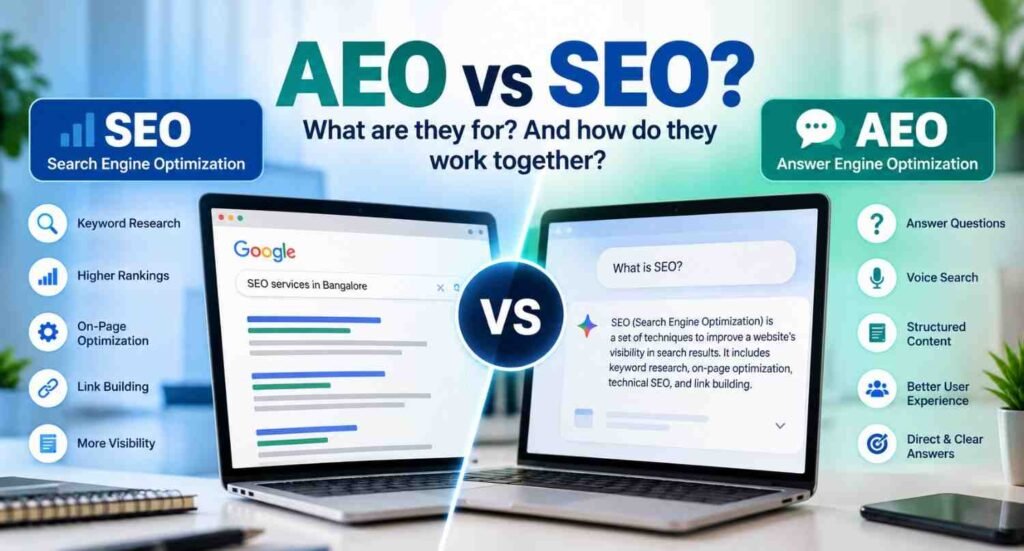
What’s AEO vs SEO? What are they for? And how do they work together?
This guide will break down these questions into digestible chunks to help you understand their differences and figure out when to use each one. So let’s get started!
Introduction
Search behaviors today show us that we’re using search engines differently than before – instead of just searching for some short keywords, we now often ask full-on questions that include conversational elements, then expect (and require) fast and accurate responses. As such, the conversation around “AEO vs SEO” has become more prominent among businesses, marketers, bloggers, and website owners looking to optimize their websites’ online presence.
If you haven’t already heard about this, you might be thinking, what’s all the talk about? After all, isn’t SEO enough?
Put simply, SEO, which stands for Search Engine Optimization, helps optimize your website to ensure better visibility in organic search results. Meanwhile, AEO, or Answer Engine Optimization, deals with providing concise and clear answers to questions asked by users. Though these two techniques focus on different aspects, they go hand-in-hand to enhance the user experience further.
In short, if you build a solid SEO strategy first, it will enable search engines to find and comprehend your content well, while leveraging AEO methods on top of this can aid in making the content more usable in case of question-based and answer-focused searches. Understanding how SEO differs from AEO is key when developing strategies to optimize your business’s online visibility while simultaneously creating content that benefits both users and search systems alike.
What Is SEO?
SEO is an acronym that means "Search Engine Optimization". It is a set of techniques aimed at improving a website by increasing its visibility in search results.
SEO includes such actions as keyword research, search intent research, on-page optimization, technical SEO, internal linking, content optimization, local SEO, mobile optimization, image optimization, and link building, with the purpose of letting search engines understand the meaning of a web page and correlate it with relevant searches.
If, for instance, a company wants to make its webpage ranked for the keyword "SEO services in Bangalore", the company's SEO tactics will include creating a separate page for the services, optimizing the title and headings, offering useful and informative material, internal linking, and having a technically perfect website.
But in modern SEO, keywords are not enough. Effective SEO takes into consideration the search intent and users' needs. It should offer useful and understandable information to visitors who are interested in it.
AEO - What Is That?
AEO is an abbreviation which means Answer Engine Optimization. This type of optimization involves writing and structuring content that will be able to clearly and effectively answer the questions asked via the search engine, voice search, and answer-oriented search experience.
While traditional SEO typically starts from a keyword, AEO gives priority to questions, answers, and user needs.
For instance, while targeting the keyword "benefits of SEO," an SEO strategy based on AEO would target such questions as "How does SEO benefit a small business?," "How much time does SEO take?," or "Why is SEO necessary for a website?"
The content that is suitable for AEO is supposed to give clear, precise, and informative answers first and then elaborate on the topic. Headings, question-oriented sections, short paragraphs, lists, tables, and FAQ can help users and search systems to understand information better.
The purpose of AEO is not to replace SEO but to supplement it.
Differences Between AEO and SEO
One of the main differences between SEO and AEO is what these strategies are primarily focused on. While SEO aims at increasing search visibility, AEO focuses on giving the answer to certain questions.
Some other important differences include:
- SEO aims at increasing visibility and rankings, whereas AEO tries to provide some valuable answers.
- SEO usually works with targeting specific keywords and searches, while AEO mainly pays attention to questions and conversational searches.
- While SEO uses technical optimization, content optimization, internal links and building authority, AEO uses answering questions, structuring the information and creating question-based content.
- SEO assists users in discovering relevant web pages, while AEO intends to assist users in finding the needed information as soon as possible.
- SEO can target both broad and specific search queries, while AEO is especially helpful when it comes to question-based and conversational searches.
- SEO focuses on the overall website and webpage, while AEO tends to focus on the single answers and information blocks.
The crucial thing is that these differences do not mean that the business should choose one of the strategies.
SEO and AEO are complementary strategies. A well-optimized page can combine SEO methods and give direct answers to the questions.
SEO vs AEO Comparison
| SEO | AEO |
|---|---|
| Search Engine Optimization | Answer Engine Optimization |
| Focuses on organic search visibility | Focuses on direct answers |
| Targets keywords and search intent | Targets questions and information needs |
| Uses on-page and technical optimization | Uses clear answers and structured content |
| Focuses on website and webpage visibility | Focuses on answering specific questions |
| Uses internal linking and content optimization | Uses question-based sections, lists, and FAQs |
| Supports traditional search visibility | Supports answer-focused search experiences |
| Requires technical and content optimization | Requires clear, concise, and useful answers |
The best strategy is not SEO versus AEO. It is SEO plus AEO. SEO provides the foundation, while AEO helps make the content more useful for people searching for specific answers.
How SEO and AEO Work Together
SEO and AEO can work together throughout the content creation process. The first step is understanding what your audience searches for. Keyword research helps identify important search terms, while question research helps identify the information users want to understand. An SEO expert can help businesses develop a strategy that combines keyword optimization with content that answers users’ questions.
For example, a business targeting "SEO services in Bangalore" can optimize its main service page for the keyword while also answering related questions such as "What are SEO services?", "How does SEO help businesses?", and "How long does SEO take to show results?"
This approach creates content that targets relevant search terms while also satisfying informational needs.
Internal linking can also support both SEO and AEO. When discussing a related topic, link naturally to another useful page on your website. For example, an article about SEO can naturally link to your on-page SEO services or local SEO services page when relevant.
The important thing is to keep internal links natural and useful. Do not add links simply to increase the number of links on a page.
How to Make Your Content Optimized for AEO
Writing AEO content requires you to understand the type of questions that your target audience poses. It is necessary for you to know the important questions surrounding your main topic so that you are able to incorporate the answers to these questions into the body of your content.
The next step involves using clear headings to show what your content is all about. Examples include headings such as "What Is SEO?", "How Does AEO work?", and "Is AEO Better than SEO?"
It is necessary for you to write an answer to the question asked right at the beginning of the paragraph. After answering the question asked, you should provide more information by means of examples, statistics, or additional data.
Using short paragraphs, bullet points, numbered lists, comparative tables, and FAQs increases readability.
Natural language is another requirement in writing optimized content for AEO. It means that the content should not contain keyword stuffing or any repetitions that are not required. In other words, you should write your content in the manner in which your users do search.
Finally, your content should contain accurate and helpful information since the goal is not to create content that will show up in an answer.
AEO Friendly Content Creation Tips
When creating content for AEO purposes, ensure that it is clear, correct, relevant, and readable. You do not have to write new content for each individual question, but instead, you can group relevant questions under one topic.
Firstly, include an introductory sentence in which you explain to the reader the purpose of your content. After that, organize your content in sections that will give answers to the most relevant questions.
Ensure that the answers are close to the question they refer to. This will enable the reader to understand the meaning immediately.
Include examples wherever possible because this will make complicated concepts more understandable to the reader. In the case of SEO vs. AEO, you can add two searches, a keyword search on one side, and a question-based on another.
It will also be a good idea to have an FAQ section to answer questions not addressed in the body of the content.
Most importantly, never create content for the sake of search engines only.
Why Traditional SEO Still Matters for AI Search
The rise of AI-based search doesn’t imply the loss of relevance of traditional SEO. SEO is still the base of assistance to the search engines in terms of discovering, understanding, and evaluating the content on websites.
The technical aspect of SEO, structuring the website, content relevancy, internal linking, mobile usability, user experience, and search intent are still the essential aspects of building a good website.
So, AEO is the additional way of optimizing the content rather than its replacement.
For instance, a technically well-developed webpage with relevant content creates a better base for the answer-orientation optimization. In case a webpage clearly defines a topic, gives the answers to the related questions, and uses logical headings, the content will be easy for people to comprehend.
Google advises to create the content that is useful and reliable for users. More details can be found here.
The future of search will be more conversational, but the principles of creation of useful and accessible content will still be relevant.
AEO vs SEO: Which One to Optimize for?
It is crucial for businesses to view AEO and SEO as separate methods of optimization. It is best to apply both simultaneously.
Begin with the basics of SEO including keyword optimization, user intent, technical SEO, high-quality content, links within the site, and the overall architecture of the website. After building a solid base, determine the questions being asked by your target audience and answer them in your content.
If your site already attracts traffic through traditional means of search optimization, then AEO will be useful in making the content you have produced more helpful to your visitors. Identify key pages on your website and try to introduce relevant sections of questions and answers, comparisons, examples, and FAQs.
When developing a new site, begin with SEO and include elements of AEO simultaneously.
SEO attracts people to your content. AEO allows them to find the answers they are looking for.
Frequently Asked Questions
What is the difference between AEO and SEO?
SEO concentrates on increasing visibility in organic searches while AEO aims to provide useful and direct answers to users' questions. Both methodologies can be used to develop more effective search-oriented content.
Is AEO going to replace SEO?
Not really. AEO does not replace SEO since SEO is still essential when it comes to optimizing websites, developing appropriate structure and increasing organic search visibility.
What does AEO mean?
AEO stands for Answer Engine Optimization. It means developing and structuring content so that it could answer questions asked by users via search engines and answer-oriented experiences.
Does AEO support SEO?
There are many overlapping principles in AEO and SEO including clarity, structure, relevancy, alignment with search intent, and useful answers to questions.
How do I make my website AEO-friendly?
First of all, it is necessary to define what questions are asked by your target audience and then to provide useful answers. It is also important to use clear headings, write naturally, structure information logically and include relevant FAQs. The other SEO principles like technical optimization and internal linking should be followed.
Should I use keywords for AEO?
Keywords can be helpful but AEO should never involve keyword stuffing. Instead of that, pay attention to the questions and information needs for which the keywords are used.
Can a single article be optimized for both SEO and AEO?
Yes. One structured article can be optimized for both SEO and AEO. Relevant keywords can be used for SEO purposes and at the same time, you will be answering the questions.
Is AEO important for small businesses?
Yes. Small businesses can use AEO to answer questions from their clients and prove their expertise.
Conclusion
The debate between AEO vs SEO does not involve favoring one strategy over the other. Although SEO and AEO strategies may have different focal points, they complement each other quite well.
While SEO strategy focuses on making sure the user finds your website, AEO strategy is focused on helping users find answers to their questions. In order to do so, SEO requires technical optimization, keyword analysis, creation of content and linking.
On the other hand, AEO will add value to the foundation laid by SEO by encouraging direct answers, using conversational language, creating clear headings and providing relevant information.
It is up to business owners and website owners to implement both SEO and AEO strategies into practice in order to achieve the best results. This means creating content based on search intent of your target group, finding out what questions they are asking and providing answers to those questions and organizing information.
The aim of this process is not to rank or become part of an answer, but to provide helpful content for a searching person.